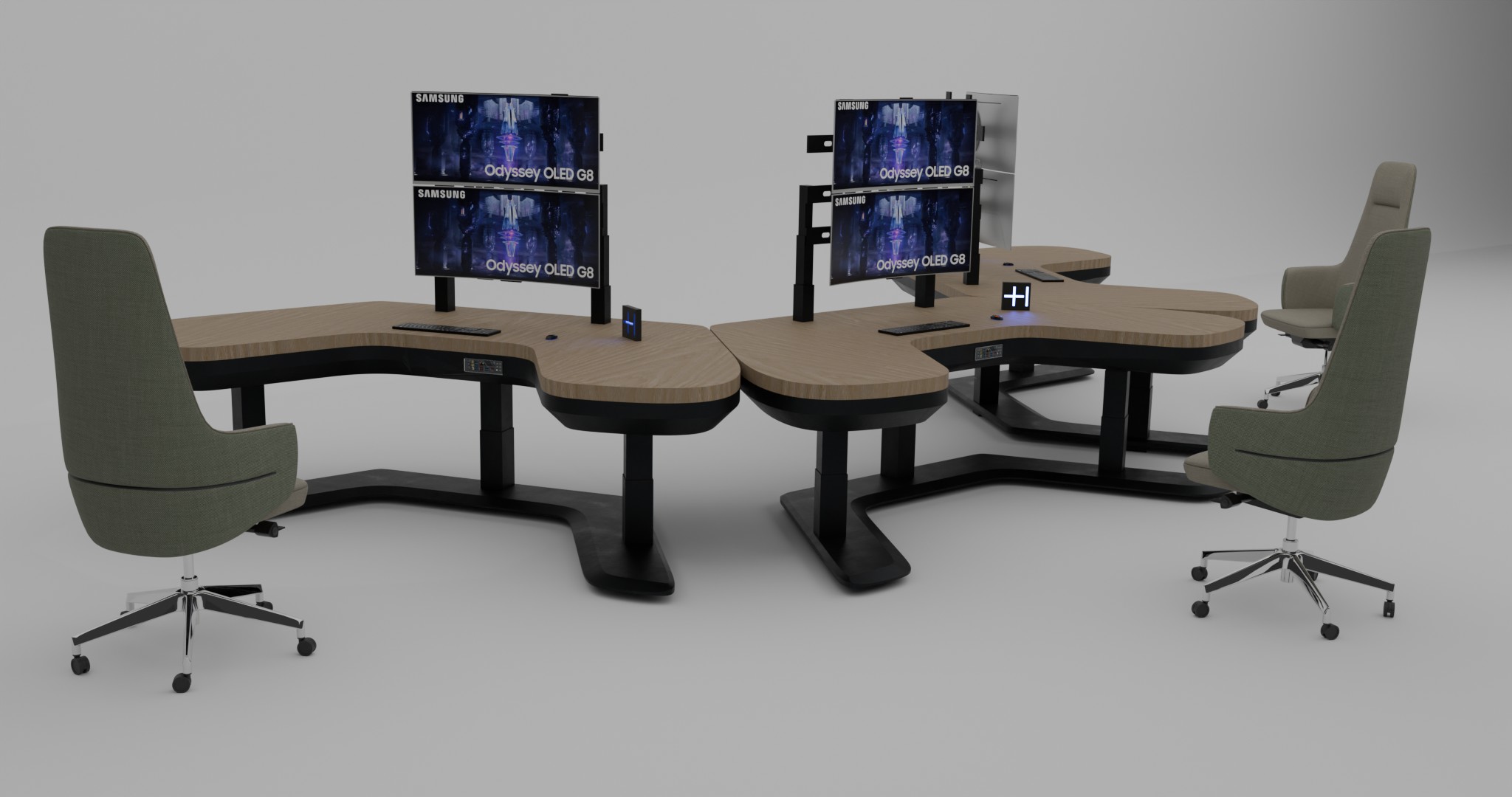
Silaron Operator Console — Workstation for Industrial Control Systems
Designing a control room workstation for operators running 8–12 hour shifts: ergonomics engineered from first principles, T1 brand integration, and structural decisions that don't force compromises.
Project context
Operator consoles for supervisory control and data acquisition systems are among the most conservative segments of industrial equipment. Functionality dominates at the expense of form, and design is treated as a secondary parameter. Yet these are the stations where people spend 8 to 12 hours a day making decisions that affect safety and production continuity.
The brief from T1 — one of Russia's largest IT holdings — called for a workstation for their Silaron SCADA system. The requirements went beyond a typical equipment spec: the console had to not just function, but reflect T1's technological maturity and stand out on the floor of competitive tenders.
A wooden tabletop in an operator console is not decoration. It's a materials engineering decision: wood reduces tactile fatigue during prolonged wrist contact, doesn't build up static charge, and psychologically lowers stress levels in high-stakes work environments.
Research and problem framing
Before any design work began, I analysed existing operator workstation solutions — Russian and international. The same structural problems appeared across manufacturers.
Problem 1: fixed geometry designed for the "average" operator
Most industrial consoles provide no tool-free adjustment. An operator at 165 cm and one at 190 cm work at the same height. Over an 8-hour shift, this translates directly into fatigue, errors, and musculoskeletal risk.
Problem 2: cable management as an afterthought
A typical operator console accumulates cable runs laid in after the fact — zip-tied, hidden under panels, or hanging loose underneath. During equipment servicing, this becomes a multi-hour puzzle.
Problem 3: uneven industrial floors
Production and control room floors are rarely perfectly level. Installing a heavy console requires shims, levelling, and sometimes structural work — significantly increasing installation cost.
Problem 4: anonymous design with no brand connection
Equipment from one manufacturer is visually indistinguishable from the next. On tender presentations and in marketing materials, this is a meaningful weakness.
Design solutions
Tool-free adjustment — tabletop height mechanism
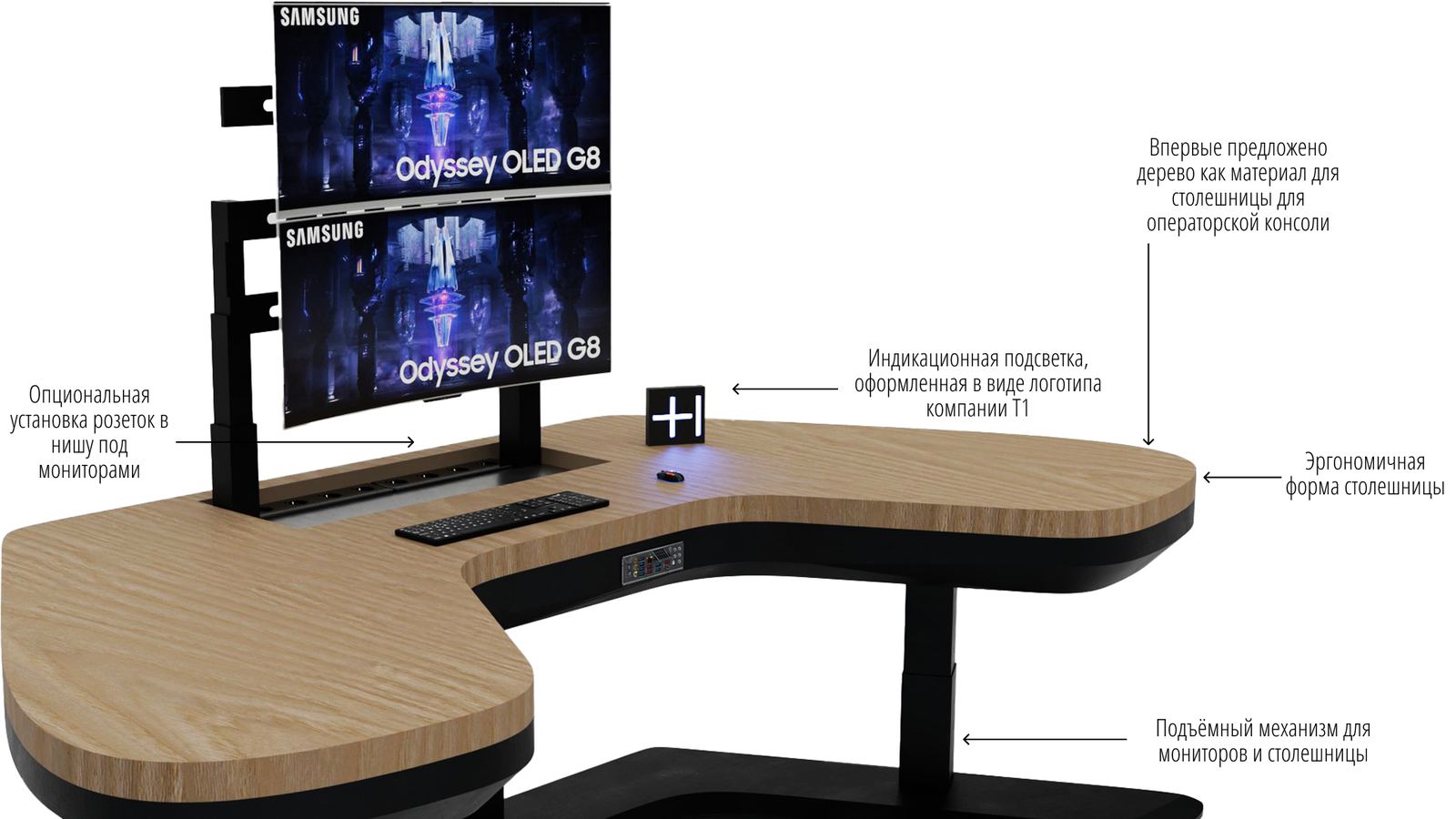
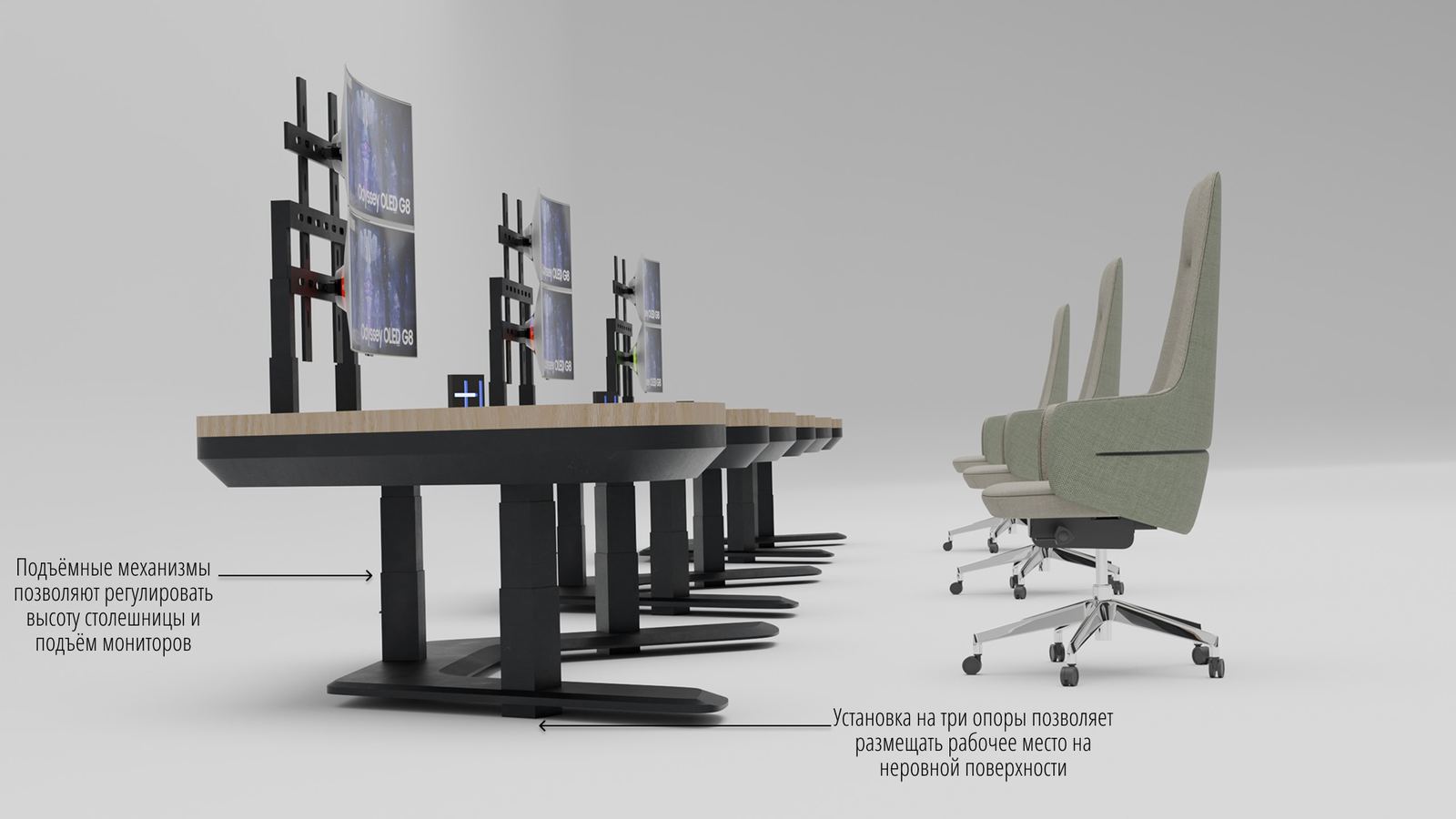
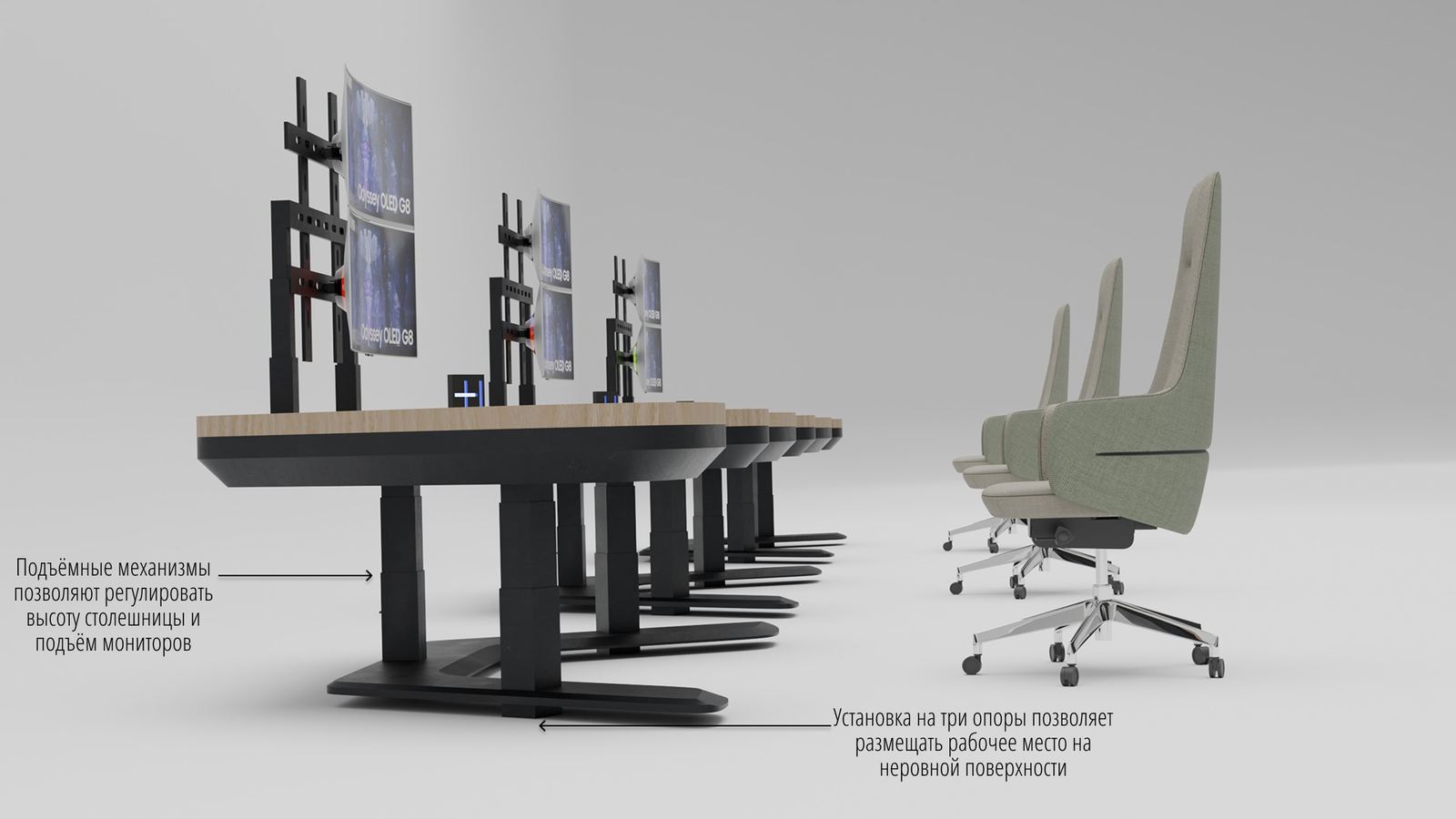
Both the tabletop and monitor bracket received independent smooth-adjustment mechanisms. An operator configures the workstation to their body in seconds, without keys or screwdrivers. The tabletop adjustment range is calculated for the 5th to 95th percentile of the Russian population by height — covering virtually every possible user.
The monitor bracket adjusts for tilt and height independently. This matters because optimal monitor position depends not just on height but on individual vision characteristics and preferred working posture.
Three legs with independent levelling
Rather than a conventional four-point base, the console uses three independently adjustable legs. Three points uniquely define a plane: the console sits without rocking on any floor, including uneven industrial surfaces. Each leg adjusts via a rotating mechanism with 1 mm increments — no tools required.
Metal cable tray with rapid access
The cable run is integrated into the structure from the start, not added after. A metal tray runs the full length of the console's lower section, closed by a panel with four snap latches. Full cable access in under 30 seconds, tool-free. The tray is sized for the anticipated wiring volume plus 30% headroom for future expansion.
Wooden tabletop — a material with engineering rationale
A solid wood tabletop with surface treatment — the first use of this material in operator consoles of this class. The rationale is multi-layered: wood is warm to the touch compared to metal and plastic, reducing tactile fatigue during continuous wrist contact. It doesn't accumulate static electricity. And psychophysiological research shows that natural materials in work environments measurably reduce subjective stress levels.
The surface treatment was selected to meet industrial equipment durability requirements — the tabletop withstands the mechanical loads typical of operator workstation use.
T1 logo indicator lighting
The brand element is integrated functionally, not decoratively. A light strip in the shape of the T1 logo serves as a system status indicator: colour and light behaviour signal the state of the connected SCADA system. The brand is visible; it doesn't interfere with work.
Design process
The project went through a complete design cycle: from research and sketching to final presentation renders and engineering documentation for production handoff.
The sketching phase covered more than 20 concepts across different stylistic directions — from strict industrial minimalism to more complex forms with pronounced surface modelling. Selection criteria were manufacturability, T1 brand alignment, and ergonomic logic.
The Siemens NX CAD model was developed in parallel with key sketching stages — enabling early detection of geometry conflicts, including in the tabletop adjustment mechanism, where the initial kinematic scheme produced unwanted play at extreme positions.
Final Keyshot renders were produced with realistic control room lighting conditions in mind: high-contrast artificial light, dark background. Materials are tuned so wood reads warm, metal reads technical, and the light strip stands out without blowing out the frame.
Ergonomic calculations
All key dimensional parameters of the console are grounded in ergonomic calculations per GOST 12.2.032-78 (Seated workplaces) and ISO 9241. Tabletop height, monitor tilt, control element placement — each parameter is tied to anthropometric data.
Particular attention went to the reach envelope: all frequently used controls sit within the optimal reach zone (radius up to 400 mm from body centre), infrequently used controls within the maximum reach zone (up to 600 mm).
Result
The Silaron console completed a full design cycle — from research through to presentation renders and an engineering documentation package. Every key design decision is backed by ergonomic calculations and material selection rationale.
The console addresses the structural problems of the operator workstation market: adapts to different operators without tools, installs on uneven floors, conceals cabling, and carries T1's brand identity through functional rather than decorative means.
What this project taught me
The main lesson: in industrial design, an engineering background changes the nature of dialogue with the development team. When a designer understands the kinematics of an adjustment mechanism, they don't suggest "make it smoother" — they identify the specific guide type and explain why the existing one produces play. Negotiations get shorter; outcomes get more precise.
The second lesson is about materials. Wood in industrial equipment looks like a provocative choice at first glance. But the unconventional choice, backed by engineering rationale, became one of the strongest elements of the concept. The client got an argument that works on a tender floor.