1. Workplace ergonomics is not "comfort" — it is a standard
In engineering circles ergonomics is still treated as "making things comfortable" — a subjective category that is hard to measure and harder to defend in front of a CFO. That is a mistake. Workplace ergonomics is an engineering discipline with formalized requirements.
The foundational document is ISO 6385, "Ergonomic principles in the design of work systems". It establishes the core principle: the workstation is designed around the human, not the other way around. National standards add concrete numbers for operator workstations: work surface height, reach zones, viewing angles, permissible control forces.
The practical meaning of standards is simple: they translate "comfortable/uncomfortable" into millimetres, degrees and newtons. For example:
- primary controls belong within arm's reach without torso bending (roughly 400–500 mm from the operator's frontal plane);
- the centre of the information display sits within ±15° of the horizontal line of sight, keeping the neck in its neutral zone;
- force on frequently used controls stays in single-digit newtons, not tens;
- for 8–12-hour shifts, a sit/stand posture change — or at least foot and forearm support — is mandatory.
When industrial design starts from these numbers rather than from enclosure styling, ergonomics stops being a "premium option" — it becomes part of the technical specification, like strength or ingress protection.
There is also a regulatory "tail" worth remembering: for display-screen workstations the ISO 9241 series applies (workstation layout, visual display requirements), and workplace certification audits check ergonomic indicators instrumentally. A manufacturer who builds standards compliance into the product spares the customer problems at certification time — a tangible competitive edge in tenders.
2. Assessment methods: RULA, REBA and NIOSH, no fluff
To argue about risks with facts, use standardized posture-and-load checklists. Three working tools cover most industrial tasks:
RULA — Rapid Upper Limb Assessment
A quick assessment of upper-body load: shoulders, forearms, wrists, neck, trunk. Every posture scores from 1 (acceptable) to 7 (immediate change required). A real example: a control-room operator who spends 6 hours per shift mousing with the shoulder raised 30° and the neck flexed 20° scores a 5 — "further investigation and changes needed". Raising the desktop by 40 mm and tilting the monitor brings the same posture down to a 3.
REBA — Rapid Entire Body Assessment
The same idea for the whole body — critical where operators stand, walk and bend toward equipment. REBA combines posture + force + grip. A typical case: lifting an 8 kg part from a 300 mm-high shelf. A deep torso bend with load scores 9–11 out of 15 — high risk. Raising the storage zone to waist level eliminates the problem without a single rouble spent on automation.
NIOSH — the lifting equation
Formalizes permissible weight for manual lifting: a baseline 23 kg multiplied by reduction factors — lift height, carry distance, torso twisting, frequency, grip quality. A worked example: a 12 kg box from the floor, 10 lifts per hour, 45° trunk twist — the NIOSH recommended limit drops to ~7 kg. The actual weight exceeds the norm nearly twofold, even though "it's only 12 kilograms" — and a back injury becomes a matter of time.
The value of these methods is not the scores themselves, but that they make risk visible before an injury — and let you compare design options numerically instead of by feel.
3. The Silaron case: 15 degrees worth 40% of fatigue
In the Silaron operator console project for industrial control systems (SCADA), the initial layout was a classic "rack": a vertical display panel and a horizontal desktop at 90° to each other. Operators work 12-hour shifts, eyes on screens, hands on keyboard and manipulators.
A RULA review showed a textbook problem: the screen centre sat above the line of sight, the operator's neck was permanently extended by 10–15°, and keyboard work added repeated downward head tilts. Over a shift that means thousands of up-down cycles, static load on the neck extensors and, by the evening shift, complaints of headaches and slower reaction times.
The solution required neither new materials nor new dimensions — only geometry:
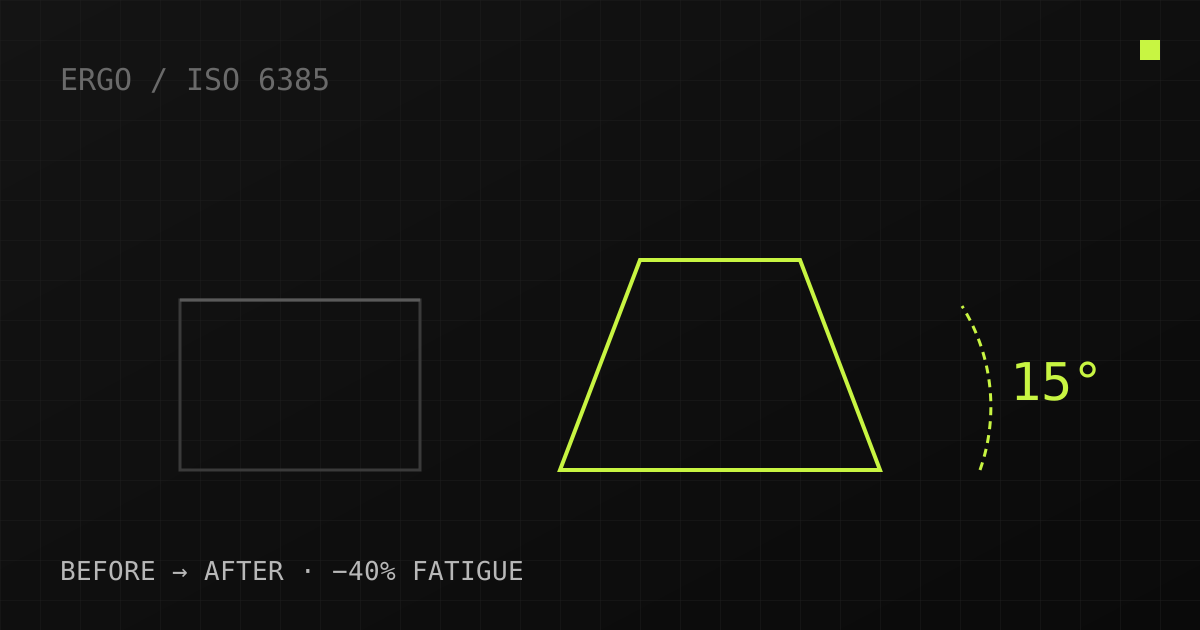
- the display panel was tilted 15° from vertical toward the operator — the screen centre entered the ±15° zone around the horizontal line of sight per ISO 6385;
- the desktop edge received an R15 radius and forearm support — removing point load from the wrists;
- frequently used manipulators were grouped within the 400 mm reach zone; rare switches moved to the periphery.
Before · 90°
Screen above the line of sight, neck in constant extension, RULA = 5
After · −15°
Screen in the neutral gaze zone, forearm support, RULA = 3
Results were measured on a pilot shift: subjective fatigue on the Borg CR10 scale at end of shift dropped by ~40%, and "stretch your neck" micro-pauses more than halved. Additional enclosure cost — effectively zero: a tilted panel is no harder to build than a vertical one if the angle is designed in from the start rather than welded in afterwards.
4. The economics: why ergonomics pays back in 6–18 months
The main argument against ergonomics is "it's expensive". Let us count honestly, for a typical two-shift operation:
| Item | Estimate, ₽/year | Comment |
|---|---|---|
| Losses from micro-pauses and end-of-shift slowdown | 180,000–350,000 | 5–8% of one operator's shift time |
| Sick leave for musculoskeletal causes | 90,000–200,000 | 1–2 cases per workstation per year |
| Fatigue-driven operator errors (scrap, downtime) | 150,000–500,000 | depends on the cost of error in the industry |
| Turnover and replacement hiring | 80,000–150,000 | recruiting, onboarding, training |
| Total losses | 500,000–1,200,000 | per problematic workstation per year |
| Ergonomic redesign at the design stage | 150,000–400,000 | one-off: analysis, 3D validation, drawing updates |
Even on a conservative estimate, production optimization through ergonomics returns the investment within 6–18 months — and keeps paying back for the entire equipment lifecycle. The key phrase is "at the design stage": changing a panel angle in a 3D model costs hours of work; changing it in a welded enclosure costs weeks and hundreds of thousands.
A separate, non-financial but measurable benefit: ergonomic equipment design becomes an argument in tenders and occupational-safety audits, and for export customers compliance with ISO 6385 and ISO 9241 is often a mandatory specification requirement.
5. Checklist: a 30-minute express audit of any workstation
A basic diagnosis needs no special equipment — just a tape measure, a protractor and this list:
- The centre of the main screen is at eye level or up to 15° below — no head tilt-back required.
- Primary controls sit within the 400–500 mm zone, reachable without torso bending.
- Work surface height matches the personnel's stature (or is adjustable).
- Forearm support exists for continuous keyboard/manipulator work.
- Desktop edges are radiused (R10–R15); nothing presses into the wrists.
- Frequent operations are performed with both hands in a symmetric zone, without trunk twisting.
- Loads above 5 kg are lifted from waist height, not from the floor.
- Posture change (sit/stand) or foot support is provided for long shifts.
- Controls are distinguishable by touch and sight — in gloves and in poor lighting.
- Hazard zones and elements are marked by colour, relief or guarding.
Every failed item is not "discomfort" but a concrete risk with a measurable price: slower pace, errors, accumulated injuries. Three or more misses are a reason for a full ergonomic review with a numerical assessment.
Conclusion
Workplace ergonomics is not about "comfort" — it is a manageable production risk with a measurable price. Assessment methods (RULA, REBA, NIOSH) formalize the problem before an injury, ISO 6385 and national standards turn it into engineering requirements, and CAD-based design lets you validate solutions virtually — before any metal is cut. The Silaron case shows the scale of the effect: 15 degrees of panel tilt, designed in on time, remove 40% of fatigue for free.
Continue with the article on Don Norman's three levels of design: how ergonomics (the behavioral level) works together with product aesthetics and meaning.
Want an ergonomic audit of your line?
We will review one workstation in a single meeting: postures, reach zones, controls — with a numerical risk assessment and a prioritized list of improvements.
Discuss your task →